
Investor Strategy
Investors
Discover stronger Tampa Bay rental-property and investment opportunities with local guidance on long-term rentals, multifamily, PadSplit, Airbnb, and neighborhood-level tradeoffs.
Fast Read
Qualify the investment conversation before you chase the next deal
Use this page to filter strategy fit quickly, review proof tied to investor-style decisions, and then jump into the county or local market pages where the deal quality changes materially.
Proof Layer
2 featured closings
Exact-address sold pages tied directly into this service conversation.
Trust Layer
2 testimonials
Relevant client proof surfaced here instead of left behind in a widget.
Video Layer
2 related videos
Transcript-backed video pages supporting the same audience and decision path.
Tool Layer
2 related tools
Useful next-step screens for pricing, seller net, or investor-side stress testing.
Question Layer
3 common questions
FAQ entries that remove friction before someone ever reaches the form.
Fit Check
Which investors this page helps most
This page is meant to separate real local underwriting from generic investor hype and make it obvious when the next move should be a local page, a proof page, or a direct deal conversation.
Best Fit
Buy-hold, house-hack, and value-add investors
Best for investors screening Tampa Bay submarkets, rental fit, renovation tolerance, and exit flexibility before falling in love with a listing.
Think Twice
Spreadsheet-only deal hunting
This page is not for investors who only want cap-rate snapshots without local judgment on flood, insurance, HOA, CDD, layout, and block-level tradeoffs.
Bring Into The Call
Strategy, budget, and hold assumptions
The strongest starting details are target strategy, budget range, financing plan, renovation appetite, rent assumptions, and which counties you are already considering.
Approach
What investor guidance has to cover
Strategy fit
Separate long-term rental, short-term rental, room-rental, house-hack, and value-add conversations instead of treating them as one investor bucket.
Risk filters
Surface flood, insurance, HOA, CDD, commute, condition, and micro-location tradeoffs early enough to matter.
Decision support
Use local guides, proof pages, and future tool pages to pressure-test a deal before the spreadsheet gives false confidence.
Client Proof
What clients say when the strategy actually works
Dillon helped me through the whole process of purchasing my first home. He was knowledgeable and went above and beyond to answer any questions I had. Highly recommend to anyone looking for their first home or investment property.
Dillon was great throughout the whole sales transaction of one of my rental properties that was a little difficult, but he was very knowledgeable and found solutions to every problem that came up. He made a difficult transaction feel manageable and really took the stress out of the entire process. He is very knowledgeable at what he does and very professional. I will definitely be contacting him for other transactions in the future.
Content Layer
Articles, videos, and tools supporting this page
Related Articles

Hillsborough Video
5 Reasons Why Investors are Choosing Tampa to Padsplit
Hey guys, welcome back. If you're an investor and you've been looking at Tampa lately, you've probably noticed the same thing I have. Traditional rentals here don't cash flow like they used to. Prices...
00:00 Intro – Why Tampa rentals don’t cash flow anymore
Hillsborough Video
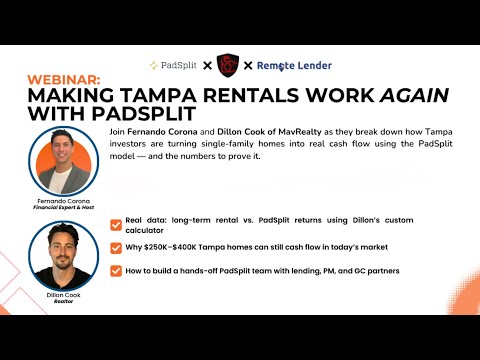
Making Tampa Rentals Work Again With Padsplit w/ Fernando Corona
is talking or I'm talking. So Dylan will will kind of go for Dylan. I'll let you take it away. Dylan will rock first and then he'll pass it over to me. >> Yeah....
Audience
00:00 is talking or I'm talking. So Dylan will will kind of go for Dylan. I'll let you take it away. Dylan will...
Related Tools
Closing Record
Closings that reinforce this service
Each closing page shows the local context, exact-address result, and decision support behind the investor conversation on this page.
Pasco
5511 CHEYENNE DR, HOLIDAY, FL
Closed at $407,500 on 2025-02-06. 3-Unit Property in Holiday. Investor side.
Pinellas
2412 51ST AVE N, ST PETERSBURG, FL
Closed at $450,000 on 2022-10-05. 2-Unit Property in Saint Petersburg. Investor side.
Local Routes
Start with the county that matches the investment strategy
Investor pages convert better when they also route into the county hubs where inventory age, insurance exposure, rentability, and exit options are easier to compare in public.
County Hub
Pasco Hub
Best for growth corridors, newer inventory, CDD-heavy areas, and address-based city coverage where the screening logic changes quickly.
County Hub
Hillsborough Hub
Best for Tampa neighborhoods, Riverview, Plant City, and mixed-strategy pockets where rentability and exit options vary block by block.
County Hub
Pinellas Hub
Best for urban and coastal inventory where insurance, flood, neighborhood feel, and use-case restrictions can kill a deal quickly.
Why It Converts
The investor page is strongest when it connects local content, deal-screening logic, and proof that the market conversation is grounded in real operating experience, not generic hype.
Investing works better when the guidance goes beyond broad market hype and listing alerts. The investor page is the entry point for comparing rental-property strategy fit, neighborhood quality, insurance and fee risk, and the operating realities that show up after closing.
Tampa Bay is not one investor market. Long-term rentals, short-term rentals, house hacks, PadSplits, multifamily, and lighter value-add plays all behave differently by neighborhood, layout, carrying cost, and exit path. That is where local context matters most.
- Separate room-rental, long-term, short-term, house-hack, multifamily, and value-add conversations instead of treating every investor the same.
- Use local guides to show where product type, tenant profile, and neighborhood trends align or conflict.
- Create a clean path into future tools and DealCooker landing pages without tightly coupling the app to WordPress.
Tell Dillon what kind of deal you are evaluating
Common Questions
Questions this page answers before you ever need a lead form
How should I evaluate a Tampa Bay investment property?
I recommend looking at three things: cash flow after all expenses, appreciation potential based on location and development trends, and the exit strategy if the market shifts.
I run comps and provide clients with property-specific ROI analysis so they can make decisions backed by numbers instead of guesswork.
What should investors screen first in Holiday?
Start with property-level condition, insurance pressure, and whether the neighborhood supports the strategy you want to run. Holiday can offer lower entry prices, but that only helps if the carrying costs, rent assumptions, and future resale story still make sense.
In other words, affordability is only the first screen. The real work is understanding what the cheaper price is buying you and what extra diligence it demands.
Is East Tampa more of a value-add market or an owner-occupant market?
It can be both, which is exactly why broad labels are not enough. Some pockets attract owner-occupants who want central Tampa access and character, while others make more sense as investor or value-add opportunities.
The right answer depends on the exact block, condition, layout, and what the long-term neighborhood story looks like around that property.